
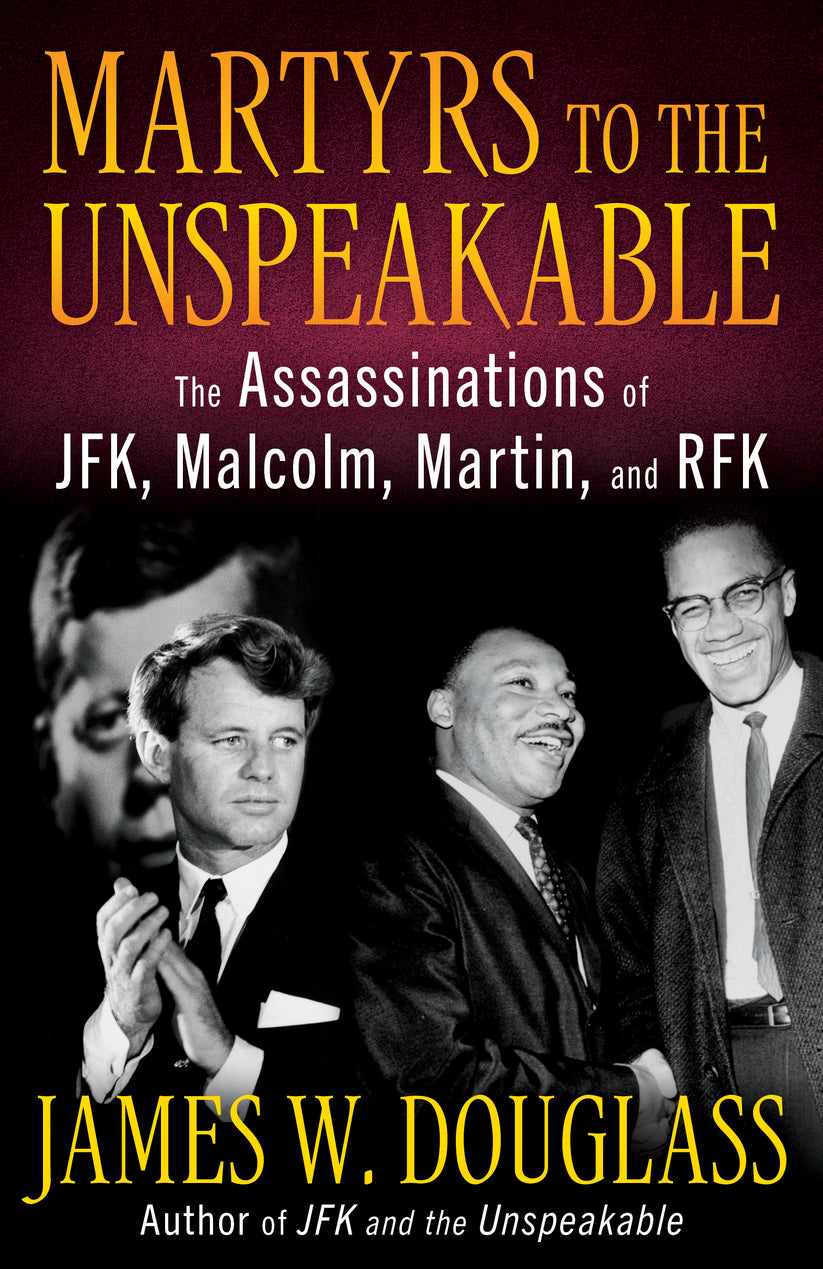
A review of "Martyrs to the Unspeakable" by James W. Douglass
Reading AudaciouslyReviewed by Wes Howard-Brook
Published 02 December 2025
I first met Jim Douglass at Ground Zero Center for Nonviolent Action, in the woods of western Washington adjacent to the Trident Submarine Base, in 1984. Already, Jim was a leading faith-based proponent of nonviolent resistance, whether to the nuclear weapons housed near the home he shared with his wife, Shelley, or other issues of peace and justice. I was a newbie, about to shift careers from lawyer to my eventual vocation as Bible teacher and writer. Jim’s wisdom, experience and gentle manner changed me forever, starting from that first meeting.
A decade later, Jim was generous enough to write a blurb for my first book, Becoming Children of God: John’s Gospel and Radical Discipleship (Orbis, 1994). His blurb included this: “Wes Howard-Brook unites patient scholarship and a way of faithful resistance to the state.”
Jim would know: no one I’ve encountered in my lifetime has modeled more clearly than Jim what “a way of faithful resistance to the state” looks like. As he tells in Martyrs to the Unspeakable (Orbis, 2025), his early career as a professor at the University of Hawaii was interrupted by Vietnam War protests, which he quickly joined, giving up his academic post to become a nonviolent war resister. In a series of now classic books, he has laid out a path of nonviolence action that takes both Jesus and Gandhi’s ways into account.
Even forty years ago, I sensed that Jim had a bigger project in mind, one that would expose the depth of evil in our world that he called, “the unspeakable,” taking a term from his friend and mentor, Thomas Merton. The first segment of this project was a 500 page investigation into the murder of John Kennedy, JFK and the Unspeakable (Orbis, 2010). It took Jim twelve years of amazingly painstaking research—including interviewing all living witnesses from the Warren Commission Report and beyond—to complete the book and then more time convincing Orbis publisher Robert Ellsberg to commit it to print. But it did get to print and became the best-selling Orbis book of all time.
Now, nearly two decades later at the age of 88, Jim has completed his project. The new volume, as long-promised, links together the four assassinations of the 60s: JFK, RFK, MLK, and Malcolm X. Not surprisingly, this volume is even longer, coming in at 562 pages of granular evidence and argument.
What is at stake in documenting for the public how the government engaged in a long-term program of assassination and deception in order to preserve the power of the few over the many? Would US-Americans accept the idea that their government murdered people whose views it found objectionable?
Perhaps in the “before times” of the early 2000s, this would have been more shocking to many than it might be today. In a world where federal power is openly used to prosecute, detain or deport people with opposing views, we are probably more prepared to accept the premises of Jim’s book than in the past.
Yet his deep historical work raises important spiritual and theological questions. In sum, Jim asks people of faith, what does it mean to “love your enemies” when the “enemies” are ruthless, cold-blooded, calculating murderers with state power at their beck and call?
Merton’s coinage, “Unspeakable,” refers to evil so enormous that words fail. Jim’s project sets out and succeeds remarkably to reveal the depth of that evil at the heart of USAmerican power. His book makes some of today’s scandals, such as that over Epstein, seem trivial.
I am not a historian. But in my work on the world of Jesus in the first century Roman Empire, I can say with confidence that the kinds of behaviors Jim labels as “unspeakable” were “business as usual” in the world of Jesus. Romans, like most imperial societies, used violence as a routine tool of securing compliance. We may find the crucifixion of Jesus shocking, but recall that not only was he not the only person murdered by the state that day, crucifixion had long been a “normal” form of public punishment used against dissenters. In coming centuries, the Roman state would murder Christian bishops for the “crime” of being Christians. A bishop who survived left us this description:
Their whole bodies were torn to shreds with clawlike potsherds until they expired. Women were tied by one foot and swung high in the air, head downward, by machines, their bodies totally naked. . . . Others died fastened to trees: they bent down their strongest branches by machines, fastened one of the martyr’s legs to each, and then let the branches fly back. . . . This went on not for a few days but for some whole years. . . . I myself saw some of these mass executions by decapitation or fire, a slaughter that dulled the murderous axe until it wore out and broke in pieces, while the executioners grew so tired they had to work in shifts.(1)
Thus, the faith question with which Jim’s book leaves us is, “what does it look like to love one’s murderous, imperial enemies?”
We may find this a difficult question today, but for the Israelites and Judeans who wrote the biblical texts, this was part of daily life over the centuries of Egyptian, Babylonian, Persian, Greek and Roman imperial control. Our biblical ancestors lived in the presence of “the Unspeakable” in a way we can hardly imagine. Jesus knew well what he was saying when he taught his disciples:
If any want to become my followers, let them deny themselves and take up their cross daily and follow me. For those who want to save their life will lose it, and those who lose their life for my sake will save it. (Luke 9.23-24)
“Pick up their cross daily.” I understand Jesus’ message here to be part of a two-fold “daily” teaching. Here’s the other half:
“Give us each day our daily bread. And forgive us our sins, for we ourselves forgive everyone indebted to us. And do not bring us to the time of trial.” (Luke 11.3-4)
In other words, each day, turn to the Creator for one’s sustenance, and also each day, see yourself as “dead” to the empire.
As Jesus exposed the lies and hypocrisy of the leaders of his time, so now Jim Douglass lays bare the mendacity at the heart of the US imperial project. Each of the four martyrs to the Unspeakable” were killed for standing against core components of the imperial project, the “triplets” so sharply named by MLK: poverty, racism, and militarism. One can, of course, say that those are simply three heads of the same Beast (cf. Revelation 13.1). Each man knew that they were targets of state violence. And each, like Jesus, Gandhi and so many others, refused to either back down or engage in violence in response.
This book is one which, honestly, I had about given up hope would see the light of day. But Jim is a persistent guy, and in his quiet but powerful scholarship has produced a work that, if taken seriously, could turn liberals into radicals. In a world where Charlie Kirk is celebrated as a model of “Christianity,” Jim offers us a clear alternative Christian way of engaging the state today. It will not work simply to denounce fascism and authoritarianism. It is not enough to “work for change” within the system as it is. As Jim Douglass’ lifetime of scholarship, activism and public witness has shown, what is required is massive, nonviolent disobedience to the violent demands of the state, regardless of the consequences.
As I completed the book, I found myself in a surprisingly upbeat mood. I realized that the key was in the book’s title: the focus is not on the evils of the CIA and J. Edgar Hoover’s FBI, but on the holy witness of the four men at the heart of the narrative. Each man, coming from very different social locations, made the difficult personal decision to risk their lives for the truth of Love. I began to see the book as a modern form of hagiography: highlighting the saintly behavior of JFK, RFK, MLK and Malcolm X as they each came to understand the reality of the world and their own responsibility to speak and act with integrity. I am deeply grateful for Jim’s incredible work over several decades in painting a picture of what binds these four as models for our own resistance to the evils of the state today.
Read it, talk about it and then get out and speak and act in response to it. As I so often experienced out at Ground Zero, resisting empire with others can actually be a lot of fun!
Visit orbisbooks.com to learn more about and purchase Martyrs to the Unspeakable.